From Fragility to Fragmentation: The New Resilience Playbook in Post-Pandemic
Executive Summary
The COVID-19 pandemic exposed deep vulnerabilities in hyper-globalized supply
From Fragility to Fragmentation: The New Resilience Playbook in Post-Pandemic Global Trade
Introduction: The Paradox of Post-Pandemic Trade
The COVID-19 pandemic delivered a dual shock to the global trading system that exposed its deepest vulnerabilities in a generation. According to the World Trade Organization, global trade volumes plunged by 5.3% in 2020, the steepest decline since the Great Depression. Yet within that collapse, a counter-narrative was quietly emerging: digital commerce surged, regional trade agreements accelerated, and supply chains began a structural transformation that continues to reshape the world economy.
The core contradiction is stark. On one hand, years of hyper-efficient, just-in-time supply chains—built around single-source dependencies, particularly on Chinese manufacturing—proved brittle when confronted with a pandemic. China’s industrial production dropped by 13.5% in early 2020, triggering cascading shortages from automotive parts to medical equipment. On the other hand, the protectionist response—over 93 trade-restrictive measures adopted globally within the first year of the crisis—risks creating new inefficiencies, raising costs, and fragmenting markets.
The thesis of this analysis is that the pandemic has not just disrupted trade—it has rewritten its DNA. The system is moving from a unipolar efficiency model toward a multipolar, digitally enabled architecture where resilience, not cost minimization, is the organizing principle. This transition is messy, uneven, and fraught with tensions, but it represents the most significant reordering of global trade since the post-war liberal order.
[IMAGE: Global map with arrows showing disrupted traditional trade flows (red) and emerging regional clusters (green)]
---
Section 1: The Fragility of Just-in-Time – How Single-Source Dependencies Backfired
The pandemic’s first lesson was brutal: decades of optimizing for low inventory and lean production created a system with zero shock absorption. China, the world’s factory, experienced a 13.5% drop in manufacturing output in January–February 2020, as reported by BBC News. The ripple effects were immediate and global. Automakers in Germany, electronics firms in South Korea, and pharmaceutical companies in the United States all faced production halts because a single component sourced from Wuhan or Guangdong was unavailable.
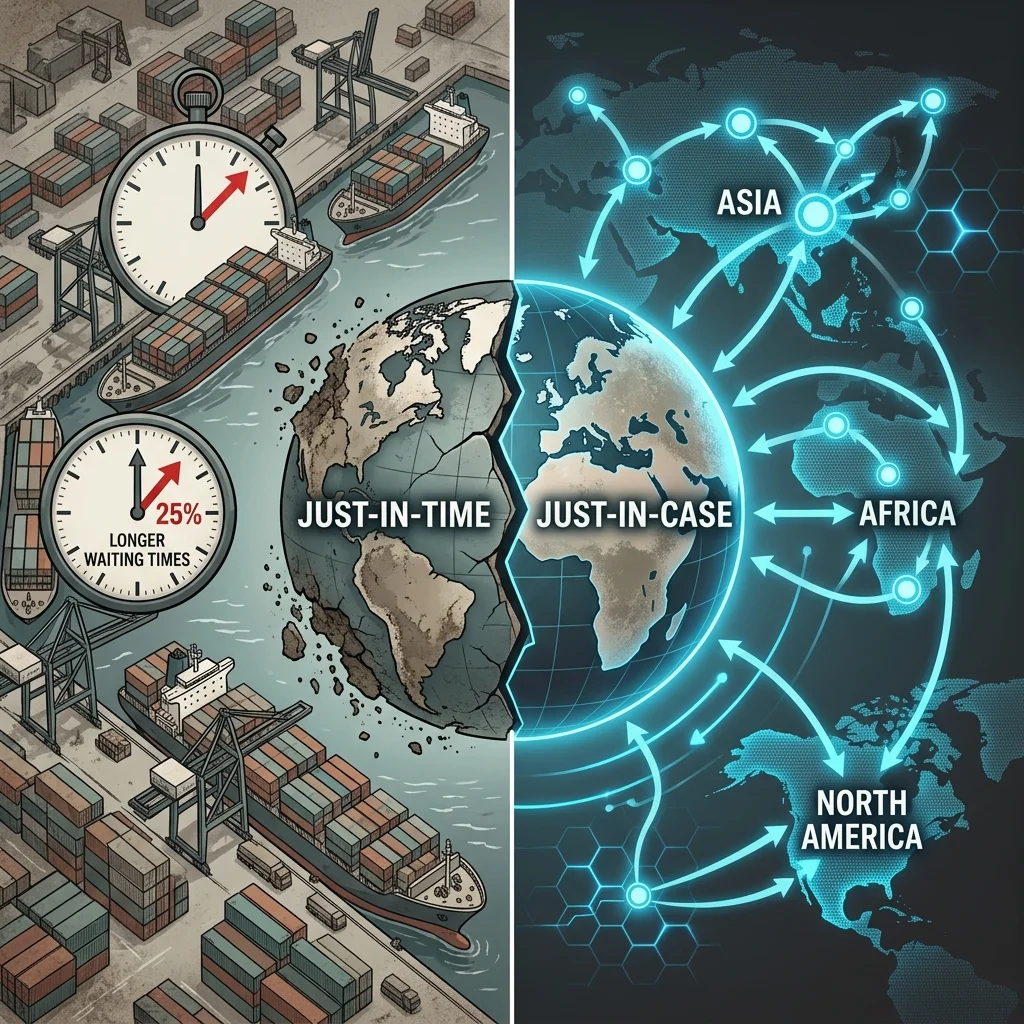
The Port of Los Angeles, the busiest container gateway in the Western Hemisphere, became a symbol of this fragility. Waiting times for vessels increased by 25% in 2020 compared to pre-pandemic levels, according to the Los Angeles Times. The congestion was not just a logistical failure; it was a systemic symptom of a supply chain model that had no buffer capacity. When demand suddenly shifted from services to goods—as consumers trapped at home bought electronics, home office equipment, and fitness gear—the just-in-time system choked.
Digital platforms, paradoxically, both absorbed the demand shock and revealed the inventory vulnerabilities. Amazon reported a 27% revenue spike in Q1 2020, as e-commerce became a lifeline for locked-down populations. But the platform’s fulfillment network buckled under the surge, leading to delays, stockouts, and a scramble to rebalance inventory. The 27% growth masked a deeper truth: even the most digitally advanced retailers were exposed to the same single-source dependencies as their brick-and-mortar counterparts.
The deep insight here is that the pandemic forced a strategic pivot from just-in-time (efficiency-driven, minimal inventory, lowest cost) to just-in-case (resilience-driven, buffer stock, multi-sourcing). This shift carries real costs. Warehousing expenses have risen, and companies now maintain higher safety stock levels. Multi-sourcing—spreading production across two or more countries—adds complexity and reduces economies of scale. The trade-off is accepted because the cost of disruption has proven to be far higher than the cost of redundancy.
[IMAGE: Infographic comparing just-in-time vs. just-in-case supply chain metrics with data points (cost, lead time, buffer stock)]
---
Section 2: Protectionism and Regionalism – The New Trade Walls and Bridges
As supply chains shattered, governments responded with a wave of trade-restrictive measures. The Global Trade Alert documented that over 93 countries adopted such measures in the first year of the pandemic, including export bans on medical supplies, food, and critical inputs. This protectionist impulse is not merely a short-term crisis reaction; it reflects a deeper shift toward economic nationalism that began before the pandemic and is likely to persist.
But alongside the walls, new bridges are being built. Regional trade agreements are gaining unprecedented momentum. The Regional Comprehensive Economic Partnership (RCEP), signed in November 2020, created the world’s largest free trade bloc, covering 30% of global GDP, according to Brookings Institution analysis. RCEP links 15 Asia-Pacific economies—including China, Japan, South Korea, Australia, and ASEAN nations—in a framework that reduces tariffs, harmonizes rules of origin, and promotes digital trade.
Meanwhile, the African Continental Free Trade Area (AfCFTA), which began trading in January 2021, is projected to boost intra-African trade by 52% by 2025, according to the United Nations Economic Commission for Africa (UNECA). For a continent where intra-regional trade currently accounts for only about 15% of total trade (compared to 60% in Europe), this represents a transformative economic rebalancing.
These regional blocs create what some analysts call “mini-globalizations”: smaller, more cohesive trading systems that reduce dependency on distant suppliers. A company in Southeast Asia can now source from within RCEP with lower tariffs and faster logistics than from Europe or North America. This regionalization reduces exposure to geopolitical shocks, such as the US-China trade war, but it also risks fragmenting the global market into competing spheres of influence.
The hidden logic is that regionalization offers a middle path between pure globalization and autarky. It preserves the benefits of trade—specialization, scale, and competition—while building in geographic and political buffers. Yet the risk is that trade blocs become exclusionary, raising barriers against non-members and entrenching regional disparities.
[IMAGE: Map showing RCEP and AfCFTA trade routes with arrows and GDP share data]
---
Section 3: Digital Platforms as Shock Absorbers – The E-commerce Leap
While physical supply chains faltered, digital trade accelerated at a breathtaking pace. E-commerce’s share of global retail sales jumped from 14% in 2019 to 17% in 2020, according to UNCTAD data, and has continued to climb since. This leap was not merely a temporary shift in consumer behavior; it represents a structural change in how trade is conducted.
Digital platforms—Amazon, Alibaba, Shopify, and hundreds of niche marketplaces—became the new intermediaries of global trade. They enabled small and medium-sized enterprises (SMEs) to reach customers across borders without the traditional barriers of distribution, customs, and payment processing. For many businesses, an online storefront replaced the physical export process.
The shock absorber function of e-commerce is often underestimated. When borders closed and shipping lanes clogged, digitally native companies could pivot quickly to new products, new markets, and new logistics providers. Data-driven inventory management allowed some firms to reroute goods from congested ports to less crowded alternatives. Platforms like Alibaba’s Cainiao network used machine learning to optimize supply chains in real time.
But the digital surge also exacerbated inequalities. Large platforms with deep pockets and sophisticated logistics networks captured most of the growth, while smaller businesses struggled to navigate cross-border e-commerce regulations, payment systems, and last-mile delivery challenges. The digital trade architecture is powerful, but it is far from evenly distributed.
The deeper implication is that digital platforms are reshaping trade governance. They set their own rules for product standards, intellectual property, and dispute resolution. They collect vast amounts of data on consumer behavior, supply chain performance, and trade flows. In effect, they are becoming private regulators of global trade, operating alongside—and sometimes ahead of—government frameworks.
[IMAGE: Line chart showing e-commerce as percentage of global retail from 2015 to 2023, with a dashed projection line]
---
Section 4: From Efficiency to Resilience – The Hidden Cost Rebalancing
The shift from just-in-time to just-in-case is not simply about holding more inventory. It represents a fundamental rebalancing of corporate strategy. For decades, the dominant metric was cost per unit. Now, resilience metrics—lead time variability, supplier concentration risk, geopolitical exposure—are being weighted equally.
This rebalancing has concrete financial implications. A 2022 McKinsey survey found that 90% of supply chain executives planned to invest in resilience capabilities, with an average cost increase of 3–6% of total supply chain costs. These investments include near-shoring production (moving manufacturing closer to end markets), building dual sourcing for critical components, and digitizing supply chain visibility through IoT sensors and blockchain tracking.
The “just-in-case” approach also calls for greater inventory buffers. Companies are shifting from quarterly to monthly or even weekly safety stock reviews. Some are maintaining “shadow inventory”—emergency reserves that are not part of normal operations but can be deployed during disruptions. This increases carrying costs, but the logic is that the cost of a single major disruption (a factory shutdown, a port closure, a sanctions regime) far exceeds the premium paid for redundancy.
The pandemic has also accelerated the adoption of digital twins—virtual replicas of supply chains that allow companies to simulate disruptions and test contingency plans. By using real-time data from suppliers, logistics providers, and customers, these models help identify single points of failure before they become crises.
Yet the resilience push is not without controversy. Critics argue that “just-in-case” adds costs that will ultimately be passed on to consumers, slowing economic growth and worsening inflation. Proponents counter that the true cost of fragility—seen in empty shelves, stalled factories, and lost output—is far larger. The evidence from post-pandemic recovery suggests that companies with diversified, resilient supply chains recovered faster and captured market share.
[IMAGE: Comparison table of just-in-time vs. just-in-case metrics: inventory days, supplier count, cost per unit, disruption recovery time]
---
Section 5: The Long View – A Multipolar, Digitally Enabled Trade Architecture
What emerges from these overlapping trends is a new global trade architecture that is fundamentally different from the one that preceded it. The old system was characterized by a single dominant logic: efficiency. Supply chains were global, concentrated, and optimized for minimum cost. The new system is multipolar, fragmented, and optimized for resilience.
Three pillars support this new architecture. First, regional trade blocs will become the primary frameworks for trade, reducing the dominance of transoceanic routes and creating more localized production networks. RCEP, the Comprehensive and Progressive Agreement for Trans-Pacific Partnership (CPTPP), AfCFTA, and the European Union’s trade agreements are all expanding their geographical and thematic coverage.
Second, digital trade platforms will serve as the connective tissue of the system. Cross-border e-commerce, digital payment systems, and data flows are enabling trade to bypass traditional friction points. The World Trade Organization is still struggling to update its rules for digital trade, but private platforms are already filling the gap, creating de facto standards for everything from cybersecurity to customs digitization.
Third, government-led industrial policy is making a comeback. The US CHIPS Act, the European Chips Act, and China’s “dual circulation” strategy all aim to build domestic production capacity in strategic sectors like semiconductors, batteries, and pharmaceuticals. This state-driven approach introduces new political dynamics into what was once a largely market-driven system.
The long-term impact of these shifts points to a world where trade is less free but more stable. Efficiency will no longer be the sole goal; resilience, security, and sustainability will share the stage. This means slower growth in trade volumes, higher costs for consumers, but also fewer catastrophic disruptions.
[IMAGE: Conceptual diagram of multipolar trade architecture: three regional blocs (Asia-Pacific, Africa, Americas) connected by digital data flows, with government policies as outer framework]
---
Conclusion: Navigating the Fragmented Future
The post-pandemic global trading system is not broken—it is being rebuilt. The old model of hyper-globalized, just-in-time supply chains was highly efficient in a stable world, but fragile in a world of shocks. The new model, shaped by regional agreements, digital platforms, and resilience-driven strategies, is more fragmented but potentially more robust.
The hidden cost of this transition is that fragmentation can also mean inefficiency. Regional blocs may duplicate production capacity, raising costs. Protectionist measures can trigger retaliation, shrinking market access. Digital platforms may accumulate too much private power, creating new dependencies. The challenge for policymakers and business leaders is to strike a balance: preserve the benefits of trade while building the buffers that protect against disruption.
The data points from the pandemic era—China’s 13.5% production drop, the 25% surge in port waiting times, the 93 trade-restrictive measures, the e-commerce leap from 14% to 17% of global retail—are not merely statistics. They are the fingerprints of a system in transformation. The question is not whether this transformation will continue, but how well we manage its contradictions.
[IMAGE: Infographic summarizing key data points: 5.3% trade volume drop, 13.5% China production drop, 25% port waiting time increase, 93 trade-restrictive measures, e-commerce 14% to 17%, RCEP 30% of GDP, AfCFTA 52% intra-African trade increase]

David Trade
Trade Routes Analyst
Focuses on international trade agreements and their geopolitical implications in emerging markets.
View full profile & more articles