Beyond the Bottom: What YouTube''s Footer Reveals About Platform Governance,
Executive Summary
At first glance, a website footer is just a collection of links. But for
What YouTube's Footer Reveals About Platform Governance, Compliance, and Innovation
Introduction: The Footer as a Strategic Document
At first glance, a website footer is little more than a collection of hyperlinks—an afterthought tucked at the bottom of a page. But for a platform as vast as YouTube, with over 2.5 billion monthly active users, the footer is a carefully curated strategic document. It is a public record of legal obligations, business priorities, and user commitments, all compressed into a few lines of text.
YouTube's German-language footer, accessible from any desktop page, contains more than 14 links spanning legal compliance (Impressum, Datenschutz, Nutzungsbedingungen), business development (Creator, Werben, Entwickler), transparency (Richtlinien & Sicherheit, Verträge hier kündigen), and innovation (Neue Funktionen testen). Each link is a deliberate choice—a signal about what the platform considers important enough to surface at the global bottom of every page.
This article decodes YouTube's footer links to uncover the hidden economic logic behind regulatory compliance, creator monetization, user rights, and innovation patterns. By examining this often-overlooked interface, we trace how Google LLC balances global regulations, market dynamics, and product evolution—offering a blueprint for understanding platform governance in the age of digital sovereignty.
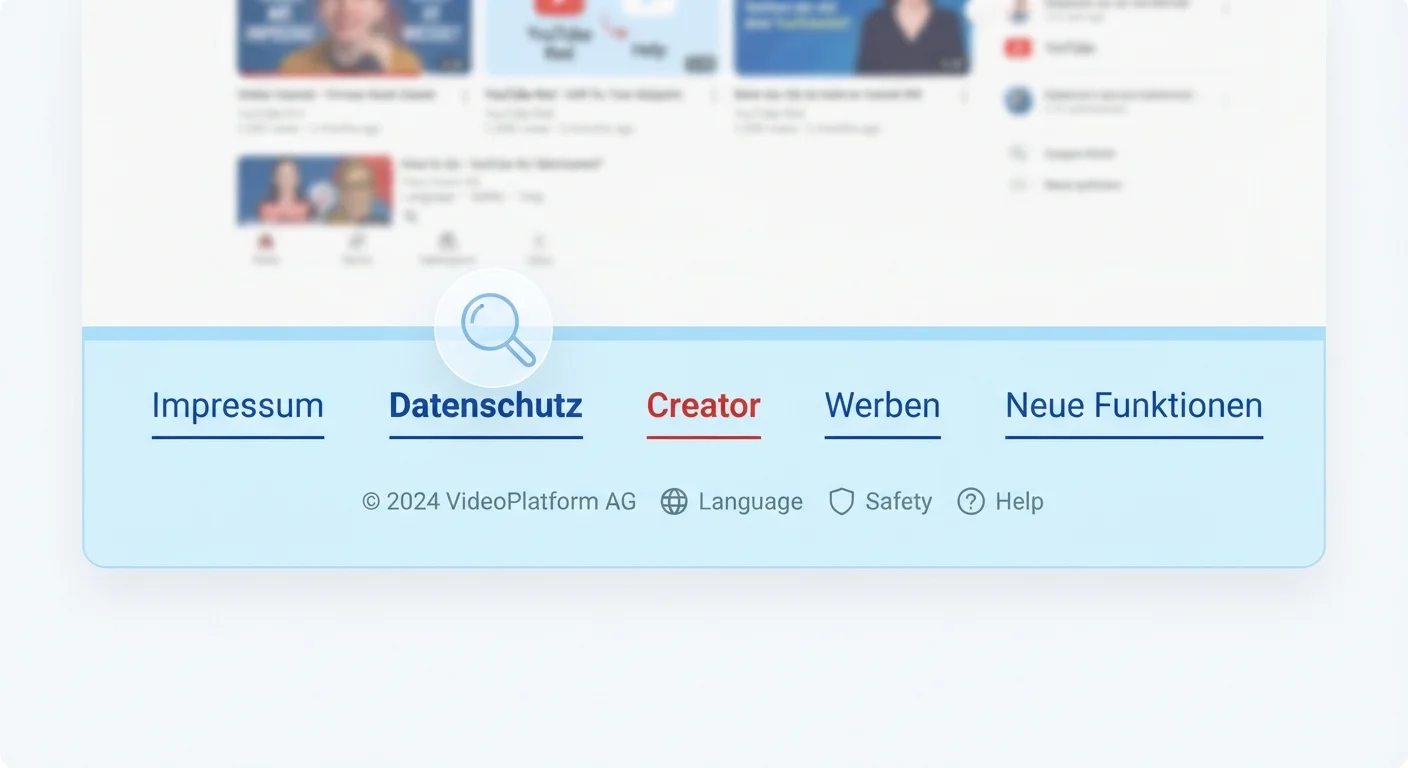
[IMAGE: Screenshot of YouTube's actual footer (desktop view) with key links highlighted: Impressum, Datenschutz, Creator, Werben, Verträge hier kündigen, Neue Funktionen testen. Light red accent on one link.]
1. Legal and Compliance Landscape: A Response to Global Regulations
The top of YouTube’s footer is dominated by legal links. Among the most specific are German-language entries: “Impressum,” “Datenschutz,” and “Verträge hier kündigen.” These are not generic privacy policies; they are direct responses to national and regional legislation.
Impressum is mandatory under Germany’s Telemediengesetz (TMG), requiring commercial websites to publish their legal name, address, and contact information. For YouTube, this means revealing Google LLC’s corporate entity and physical address—a transparency measure that many platforms resist in other jurisdictions. The presence of this link signals that YouTube treats German regulatory requirements as non-negotiable, likely due to the size of the German-speaking market (over 80 million internet users) and the aggressive enforcement practices of German data protection authorities.
Datenschutz links to YouTube’s privacy policy, shaped primarily by the European Union’s General Data Protection Regulation (GDPR). GDPR has forced global platforms to restructure data collection, retention, and user consent mechanisms. The footer placement ensures that every user—not just those who click “Privacy” in settings—can access this information with one click, satisfying the GDPR’s requirement for “easily accessible” privacy notices.
Verträge hier kündigen is a fascinating addition. German consumer law grants users the right to cancel certain digital contracts (e.g., YouTube Premium subscriptions) via a dedicated “cancellation button.” YouTube’s inclusion of this link in the footer shows how platforms must adapt to country-specific consumer protections. It also reflects a broader trend: the fragmentation of internet governance along national lines.
Beyond these German-specific links, YouTube’s footer includes “Urheberrecht” (copyright) and “Richtlinien & Sicherheit” (policies and safety). Copyright compliance is a major cost center for YouTube—the platform processes millions of Content ID claims annually. By placing a copyright link in the footer, YouTube signals its proactive approach to intermediary liability, a key requirement under the EU Digital Services Act (DSA) and US Section 230 jurisprudence.
[IMAGE: World map with highlighted regions (EU, US, India) and legal icons (gavel, shield) overlaid on a footer link list. Arrows from highlighted regions to specific footer links like Impressum, Datenschutz, Richtlinien & Sicherheit.]
The evidence is clear: YouTube’s footer is a compliance dashboard. Each link corresponds to a specific regulatory burden—GDPR in Europe, TMG in Germany, DSA transparency requirements, copyright safe harbor in the US. As digital sovereignty laws proliferate (Brazil’s LGPD, India’s DPDP Act, Japan’s APPI), we can expect footers to grow longer and more jurisdiction-specific.
2. The Creator Economy and Monetization Infrastructure
Immediately beside the legal links, YouTube’s footer prominently features “Creator” and “Werben” (Advertise). These two links represent the twin pillars of YouTube’s business model: enabling content creators to upload and monetize, and enabling advertisers to reach those creators’ audiences.
Creator directs users to a hub for video publishing tools, analytics, monetization policies, and best practices. For a platform competing with TikTok, Twitch, and Instagram for creator loyalty, this link is a strategic investment. It signals that YouTube is not merely a video repository but a creator ecosystem—offering resources for education, community building, and revenue generation. The footer placement ensures that even casual viewers are one click away from becoming creators, fueling the supply side of the platform.
Werben (Advertise) points to Google Ads and YouTube advertising solutions. This is YouTube’s primary revenue engine: in 2023, YouTube’s advertising revenue exceeded $31 billion. The link’s presence in the footer makes it accessible to small businesses and independent marketers, not just large agencies. It reflects YouTube’s dual-sided market strategy—where the platform must simultaneously attract creators (supply) and advertisers (demand) to sustain its growth.
Entwickler (Developers) is an often-overlooked link that points to YouTube’s API documentation, data tools, and integration resources. This reveals YouTube’s ambition beyond content uploads: it wants to be an extensible platform, powering everything from third-party video editing apps to AI-driven content analysis. The developer link is an invitation to build on YouTube’s infrastructure, creating a sticky ecosystem that rivals Apple’s App Store or Facebook’s Graph API.
[IMAGE: Three interconnected circles labeled "Creator," "Werben," "Entwickler" with arrows indicating flows: content from creator to platform, ad spend from advertiser to platform, and API integrations from developer to platform. YouTube logo in the center.]
Market dynamics are at play here. TikTok’s explosive growth has forced YouTube to double down on creator tools (e.g., Shorts, improved editing features). The footer link to Creator resources is a competitive signal: “We are investing in you.” Meanwhile, the advertising link competes directly with Meta’s ad platform and Amazon’s growing video ad business. By placing both links side by side, YouTube acknowledges that its economic model depends on balancing these two constituencies—a delicate act visible even in the footer.
3. User Rights and Transparency: The Cancellation Clause
The link “Verträge hier kündigen” (Cancel contracts here) is one of the most user-empowering elements in YouTube’s footer. It directly addresses a growing demand for digital consumer rights: the ability to easily terminate subscriptions and services.
Under German law (Section 327 of the BGB), users who enter into digital service contracts (such as YouTube Premium, YouTube Music, or channel memberships) must have a clear, unmissable option to cancel. YouTube’s implementation is a case study in compliance design: the cancellation link is not buried in account settings but prominently displayed in the global footer. This low-friction approach reduces support costs and potential legal disputes, while also building user trust.
But the implications go beyond Germany. Consumer protection regulators in the EU, UK, US, and Australia are increasingly scrutinizing “dark patterns” that make cancellation difficult. YouTube’s public cancellation link serves as a best-practice example—and a subtle competitive advantage against platforms that still hide their cancellation flows behind multiple clicks.
The link also ties into YouTube’s broader transparency initiatives. “Richtlinien & Sicherheit” links to community guidelines, copyright policies, and safety reporting tools. In an era of misinformation and harmful content, these links are not just legal requirements but trust-building mechanisms. YouTube’s transparency reports, published quarterly, detail how many videos are removed, how many appeals are filed, and how quickly enforcement happens. The footer grounds these high-level promises in actionable links.
[IMAGE: A flowchart showing a user clicking "Verträge hier kündigen" from the footer, then landing on a page with clear buttons: "Cancel YouTube Premium," "Cancel Channel Membership," etc. Simple, clean interface.]
User rights are often framed as adversarial to platform profits. But YouTube’s footer suggests a different logic: making cancellation easy can reduce churn through increased trust, while transparent safety policies differentiate the platform from less regulated competitors. This is platform governance as a competitive asset.
4. Innovation and Experimentation: The Beta Strategy
Perhaps the most intriguing link in YouTube’s footer is “Neue Funktionen testen” (Test new features). This leads to a page where users can opt into experimental features—from redesigned layout options to AI-powered comment summaries or new video playback controls.
This link embodies YouTube’s innovation strategy: instead of forcing new features on all users at once, the platform uses an opt-in beta model. This minimizes backlash from changes that disrupt existing workflows, while generating real-world usage data before wide rollout. The footer placement makes the experiment program discoverable but not intrusive—a user must actively choose to participate.
The range of features tested through this program is revealing. Recent experiments include:
- AI-generated video summaries (testing machine learning on content understanding)
- Comment sentiment analysis (testing moderation tools)
- New navigation and search interfaces (testing UX improvements)
- Long-form video variable speed controls (testing accessibility features)
Each experiment reflects a strategic priority: AI integration, community health, user interface innovation, and accessibility. By keeping these experiments in the public eye via the footer, YouTube signals a culture of continuous iteration—and gathers feedback from its most engaged users.
[IMAGE: Mockup of the "Neue Funktionen testen" landing page showing a list of experimental features with toggle switches. Examples: "AI video summaries," "New video player design," "Automated captions improvement." Each has a "Learn more" link.]
The innovation link also serves a marketing purpose. It positions YouTube as a forward-looking platform, competing with the rapid feature releases of TikTok and the AI innovations of companies like OpenAI. In an industry where stagnation can mean irrelevance, the footer’s beta program is a low-cost signal of dynamism.
Conclusion: The Footer as a Mirror of Platform Logic
YouTube’s footer is far more than a navigation aid. It is a condensed representation of the platform’s operating model: a system that must simultaneously comply with fragmented global regulations, attract and retain creators and advertisers, empower users without sacrificing revenue, and innovate rapidly without destabilizing its core experience.
The 14+ links reveal several enduring tensions:
- Local vs. global: German-specific laws sit alongside US-default policies, reflecting the challenge of scaling a platform across jurisdictions.
- Creator vs. advertiser: The adjacent placement of Creator and Werben links highlights the dual-sided market dynamic that generates YouTube’s revenue.
- User rights vs. business interests: The prominent cancellation link shows that compliance with consumer protection can coexist with commercial goals.
- Stability vs. innovation: The beta testing program balances the need for a reliable core product with the pressure to experiment.
For researchers, policymakers, and competitors, YouTube’s footer is a living document of platform governance. As digital sovereignty laws tighten and the creator economy evolves, these links will change—new ones will appear (e.g., “AI Policies,” “Data Portability”), and old ones may be relocated. But the underlying logic will remain: a platform’s bottom navigation reveals what it values, what it fears, and what it prioritizes.
The next time you scroll to the bottom of a YouTube page, pause and scan these links. They tell a story not just about one website, but about the future of digital platforms in a world of increasing regulation, competition, and user expectations.
[IMAGE: A split image. Left side: a close-up of a website footer with blurry links. Right side: the same footer with each link labeled with an icon—gavel for legal, dollar sign for business, shield for safety, lightbulb for innovation. The overall image conveys decoding/unlocking hidden meaning.]

James Maritime
Chief Markets Correspondent
Former Bloomberg analyst with 15 years covering Asian markets and international commodity trade.
View full profile & more articles