Navigating the New Global Order: Digitalization, Geopolitics, and Sustainability
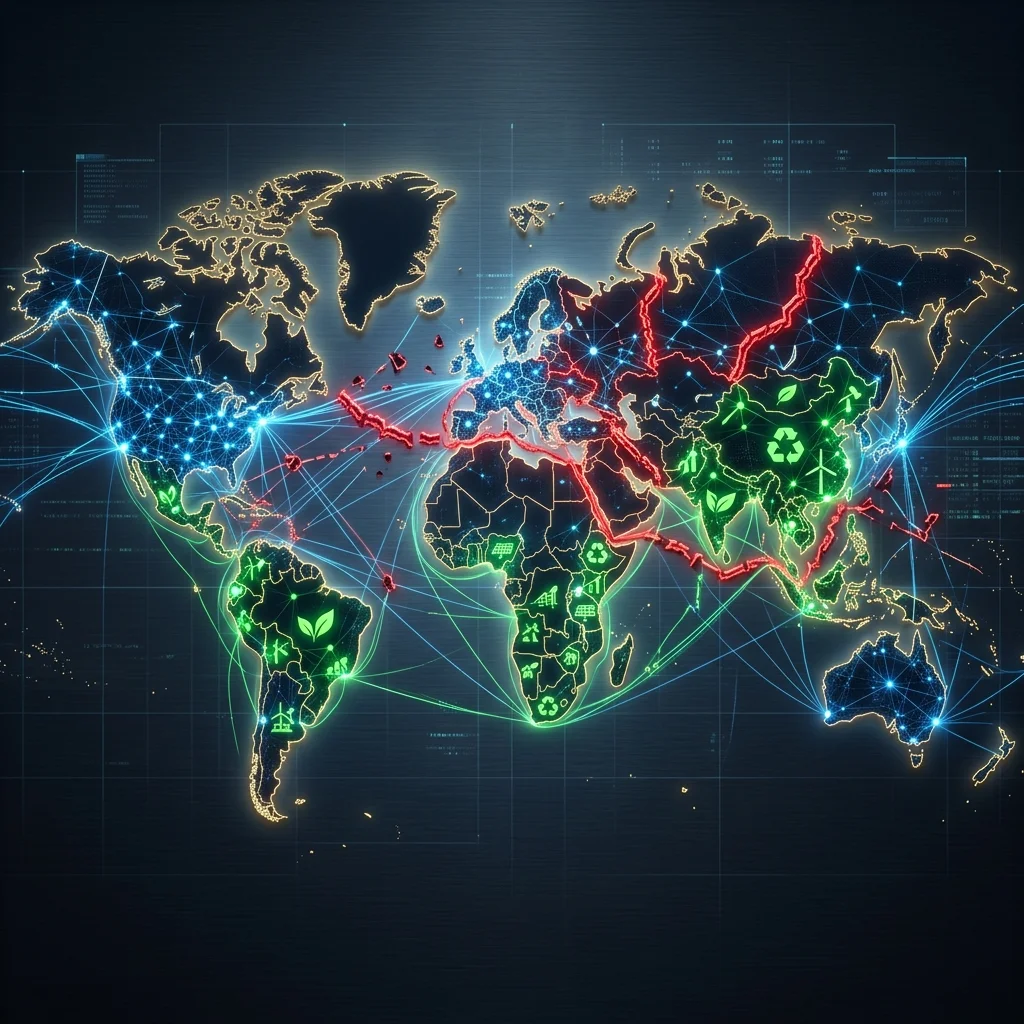
Executive Summary
The global business landscape is undergoing a seismic shift driven by digitalization,
The Triple Disruption: How Digitalization, Geopolitics, and Sustainability Are Reshaping Global Business
The global business landscape is undergoing a seismic shift. Three forces—digitalization, geopolitical fragmentation, and the sustainability imperative—are converging to redraw the rules of international commerce. A 2024 study by Sangkyu Park in the Academy of Accounting and Financial Studies Journal provides a strategic audit of this new reality, arguing that companies must abandon old playbooks built on cost-minimization and linear supply chains. Instead, success now demands foresight, adaptability, and strategic agility in the face of fragmented markets, rising protectionism, and ESG-driven capital flows.
This article unpacks the three core disruptions and examines how emerging markets in Asia, Africa, and Latin America are becoming both risk and opportunity zones. For executives, policymakers, and investors, the message is clear: the old global order is gone, and the new one requires a fundamentally different approach to international business strategy.
---
The Digital Revolution and Its Discontents
Digitalization—including e-commerce platforms, artificial intelligence algorithms, and cloud-based infrastructure—is reshaping industries at an unprecedented pace. For international businesses, digital tools offer new pathways to reach customers, optimize logistics, and personalize offerings across borders. AI-driven demand forecasting, automated warehousing, and blockchain-enabled traceability are no longer futuristic concepts; they are operational realities.
Yet the same technologies that drive efficiency also introduce geopolitical vulnerabilities. Trade tensions between the United States and China, for instance, have spilled into the digital domain. Export controls on advanced semiconductors, restrictions on data flows, and the push for "digital sovereignty" by nations like India and the European Union are forcing companies to redesign their digital supply chains. The hidden economic logic is stark: digital innovation accelerates both efficiency gains and geopolitical risks, requiring a strategic balance.
Consider the case of cross-border data flows. E-commerce giants that once treated data as a frictionless global resource now face a patchwork of localization requirements, privacy laws, and surveillance concerns. A company operating in both the U.S. and China may need separate data centers, different AI models trained on locally compliant datasets, and distinct cybersecurity protocols. This "digital decoupling" raises costs and slows innovation, but ignoring it invites regulatory sanctions or market exclusion.
[IMAGE: Graphic showing AI algorithms connecting global markets but with a visible chasm between the US and China, symbolizing digital decoupling.]
The strategic takeaway is that digitalization cannot be pursued in isolation from geopolitical reality. International business strategy must now embed digital resilience—redundant systems, flexible cloud architectures, and compliance teams that span multiple jurisdictions—as a core competency.
---
The Geopolitical Chessboard – Risk Management in a Fractured World
Geopolitical risks have moved from the periphery to the center of corporate boardroom discussions. Territorial disputes, sanctions regimes, trade wars, and the weaponization of economic interdependence are creating a fractured global landscape. The COVID-19 pandemic served as a brutal stress test, exposing deep vulnerabilities in supply chains that had been optimized for just-in-time efficiency. When borders slammed shut, factories halted, and shipping lanes clogged, companies discovered that supply chain resilience mattered more than marginal cost savings.
Sangkyu Park's research underscores that navigating these tensions requires "foresight, adaptability, and strategic agility." In practice, this means diversifying sourcing away from single-country dependencies, building buffer inventories, and investing in regional hubs. For example, many electronics manufacturers are now pursuing a "China + 1" strategy, maintaining operations in China while adding capacity in Vietnam, Mexico, or India. This does not eliminate geopolitical risk, but it creates operational options.
The fragmentation is not limited to Asia. The Russia-Ukraine war disrupted energy, agriculture, and metals markets. U.S.-EU trade disputes over digital taxes and aircraft subsidies continue to simmer. Sanctions on Iran and North Korea affect shipping routes and banking corridors. For international businesses, the cost of ignoring geopolitical risk is no longer hypothetical—it appears in the form of stranded assets, supply chain ruptures, and reputational damage.
[IMAGE: A stylized chessboard with countries as pieces and supply chain links as moves, some paths blocked by red barriers.]
Effective risk management now requires scenario planning that goes beyond financial modeling. Companies must employ geopolitical analysts, engage with diplomatic channels, and build political risk insurance into their capital budgets. The days when a CFO could view geopolitics as a soft issue are over.
---
Sustainability as a Strategic Imperative – Beyond Greenwashing
Consumer awareness and regulatory pressures are driving a fundamental shift: sustainability is no longer a niche concern but a strategic imperative. Reducing carbon emissions, ensuring responsible sourcing, and embracing circular economy principles have moved from corporate social responsibility reports to the heart of international business strategy.
The most powerful catalyst has been the rise of ESG investing. Institutional investors and asset managers now systematically evaluate companies based on environmental, social, and governance factors. A weak ESG rating can increase the cost of capital, trigger shareholder activism, and exclude a firm from major investment funds. According to Bloomberg Intelligence, global ESG assets are on track to exceed $50 trillion by 2025, representing more than a third of total assets under management.
This shifts the dialogue from compliance to competitive advantage. Companies that integrate sustainability into their core operations attract capital, win customer loyalty, and often discover operational efficiencies they had overlooked. For example, a multinational consumer goods firm that redesigns its packaging to reduce plastic use not only meets regulatory targets in Europe but also lowers shipping weight and carbon footprint, cutting logistics costs.
[IMAGE: A balance scale with a globe on one side and green leaves on the other, financial charts and ESG rating icons in the background.]
However, the path is fraught with pitfalls. Greenwashing—making misleading claims about environmental performance—has drawn increased scrutiny from regulators and NGOs. In 2023, the European Union adopted the Green Claims Directive, requiring companies to substantiate environmental labels with scientific evidence. Similarly, the U.S. Securities and Exchange Commission has proposed rules mandating climate-related disclosures. For international businesses, operating across multiple jurisdictions with different standards creates complexity but also opportunity: those that genuinely embed sustainability can differentiate themselves in crowded markets.
Key areas of focus include supply chain decarbonization (scope 3 emissions, which often account for 80% or more of a company's carbon footprint), sustainable raw material sourcing (cocoa, cotton, lithium, and rare earths), and human rights due diligence in emerging market operations. The reputational and financial risks of failing in these areas are substantial, as seen in lawsuits against fast-fashion brands for labor abuses or oil companies for climate deception.
---
The Rise of Emerging Markets – Localization in a Multipolar World
Emerging markets in Asia, Africa, and Latin America are no longer just low-cost production bases—they are increasingly the drivers of global growth. By 2030, three of the four largest economies are projected to be outside the OECD: China, India, and Indonesia. Africa's combined GDP is expected to surpass $4 trillion, while Latin America's digital economy is booming.
Yet these markets also present unique challenges. Market fragmentation means that a single strategy rarely works across countries. Regulatory environments differ wildly; infrastructure gaps persist; and cultural, linguistic, and political nuances demand localization. The old model of exporting a standardized product from a global hub is giving way to a "glocal" approach: global technology platforms adapted to local tastes, payment systems, and distribution channels.
Consider the case of e-commerce in Southeast Asia. While global players like Amazon have struggled, regional platforms such as Shopee and Lazada have thrived by integrating local payment methods (e.g., cash-on-delivery in Indonesia), partnering with mom-and-pop stores for last-mile delivery, and offering tailored product assortments. Similarly, in Africa, mobile money platforms like M-Pesa have leapfrogged traditional banking, creating opportunities for fintech companies that understand local regulatory and social dynamics.
[IMAGE: A world map highlighting emerging markets in Asia, Africa, and Latin America with upward arrows and local cultural icons like spices, masks, and textiles.]
For international businesses, the key is to balance global scale with local relevance. This often means setting up regional headquarters, hiring local talent for senior roles, and co-creating products with local partners. Joint ventures and strategic alliances have become more common than outright acquisitions, as they allow risk-sharing and faster adaptation.
Sustainability also plays a role in emerging markets. Many developing nations are rich in natural resources critical to the green transition—lithium in Chile and Argentina, cobalt in the Democratic Republic of Congo, rare earths in Vietnam. International businesses that engage responsibly, respecting local communities and environmental standards, can secure long-term access and build goodwill. Those that extract without reciprocity risk expropriation, protests, and reputational harm.
---
A Roadmap for Strategic Agility
Sangkyu Park's research offers a clear message: the international business environment is no longer predictable, but it is navigable. Companies that succeed will be those that treat digitalization, geopolitics, and sustainability not as separate silos but as interconnected drivers of strategy. Here is a practical roadmap:
- Invest in strategic foresight. Build internal capabilities for scenario planning, geopolitical analysis, and trend monitoring. Use tools like war-gaming and horizon scanning to anticipate disruptions before they hit.
- Rethink supply chains for resilience. Move from just-in-time to "just-in-case." Diversify sources, build buffer capacity, and use digital twin simulations to stress-test vulnerabilities.
- Embed ESG into core business, not peripheral reporting. Align capital allocation with sustainability goals. Use ESG metrics to drive innovation, reduce costs, and attract patient capital.
- Localize in emerging markets without diluting global identity. Hire local leadership, adapt products to local preferences, and build partnerships that create shared value.
- Embrace strategic agility as a cultural norm. Encourage decentralized decision-making, reward experimentation, and maintain financial flexibility to pivot when the landscape shifts.
The new global order is fragmented, contested, and fast-changing. But for those who understand its dynamics, it also offers extraordinary opportunities. The winners will not be the largest incumbents—they will be the most adaptable.

James Maritime
Chief Markets Correspondent
Former Bloomberg analyst with 15 years covering Asian markets and international commodity trade.
View full profile & more articles